
AI Won’t Fix What’s broken. Every few months, there’s a new technology that promises to revolutionize the way you do business. Right now, that technology is AI. Business owners everywhere are rushing to implement AI tools, automate their workflows, and slap a “powered by AI” badge on their products.
But here’s the uncomfortable truth nobody wants to say out loud — if your business is already struggling, AI isn’t going to save it. In fact, it might just make things worse, much faster.
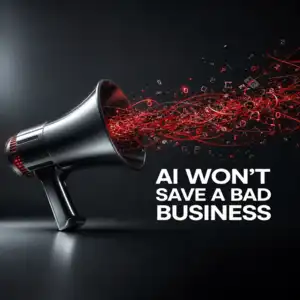
AI Amplifies Your Mess, Not Your Success
Think of AI as a megaphone. A megaphone doesn’t change what you’re saying — it just makes it louder. If you’re already delivering a clear, compelling message to the right audience, a megaphone is incredible. But if you’re standing in the wrong room, talking to the wrong people, saying the wrong things? A megaphone just fills the entire building with noise. That’s exactly what AI does to a broken business. It doesn’t fix the signal — it amplifies the static.
Why business get automation
Here’s where a lot of business owners get tripped up. They see a competitor using AI to automate customer service, generate content, or streamline operations, and they assume the AI is the reason that competitor is winning. What they don’t see is the years of process refinement, customer understanding, and operational clarity that came before the AI was ever introduced. The AI didn’t create that success — it accelerated what was already working. You can’t shortcut your way to that foundation by buying a subscription to the latest tool.
If you are not ready for AI?
The businesses that suffer most from premature AI adoption are the ones with unresolved core problems. Bad customer service doesn’t become good customer service when you automate it — it becomes bad customer service at scale. Confusing messaging doesn’t become clear messaging when you feed it into a content generator — it becomes a flood of confusing content across every channel.
Weak sales processes don’t become strong ones when AI books more calls — you just end up with more prospects experiencing a broken sales experience. AI is brutally efficient at doing exactly what you tell it to do, and if what you’re telling it reflects a broken system, efficiency becomes your enemy.
Fix the Foundation Before You Add the Tech
Before you spend another dollar on AI tools, you need to get brutally honest about what’s actually going on inside your business. Do you have a clear understanding of who your customer is and what they really need? Do your team members know what’s expected of them, and do they have the resources to deliver?
Is your core offer genuinely solving a real problem, or are you still guessing? These aren’t questions that AI can answer for you — they require real introspection, honest data, and sometimes uncomfortable conversations. Skipping this step and jumping straight to automation is like putting a fresh coat of paint on a house with a crumbling foundation.
So what is AI for then
The businesses that get the most out of AI are the ones that treat it as an enhancement, not a rescue plan. They’ve already done the hard work of defining their processes, understanding their customers, and building a team that knows how to execute. When they bring in AI, it’s to do more of what’s already working — faster, cheaper, and at greater scale.
They’re not hoping AI will figure out their business model for them. They’re using AI to double down on a model that’s already proven. That’s a fundamentally different relationship with technology, and it produces fundamentally different results.
What questions should you ask?
So before you rush to implement the next AI tool your favorite guru is promoting, take a step back and ask yourself the harder question. What is actually broken in your business right now, and why haven’t you fixed it? Is your customer retention low because you need better automation, or because your product genuinely isn’t delivering value?
Are your leads not converting because your follow-up is slow, or because your offer isn’t compelling enough? Fix those things first. Build the processes, train the people, refine the offer, and earn the trust of your market. Once that foundation is solid, AI becomes one of the most powerful tools you’ve ever used. But without it, AI is just an expensive way to fail more efficiently.
So is it the AI’s fault, that AI Won’t Fix What’s broken?
AI is not the villain here — bad strategy is. The technology itself is genuinely remarkable, and when used correctly, it can give small businesses capabilities that only large corporations could afford a decade ago. But technology has never been a substitute for clarity, discipline, and genuine value creation. The businesses that will thrive in an AI-powered world aren’t the ones who adopted it earliest — they’re the ones who built something worth scaling before they ever touched the tools. So here’s the question you need to sit with today: is your business actually ready for a megaphone, or are you just hoping the volume will drown out the problems you’ve been avoiding?
AI Won’t Fix What’s Broken links:
Some useful links: INX->, or contact us to talk about AI Won’t Fix What’s does it means you?.