
Table of Contents
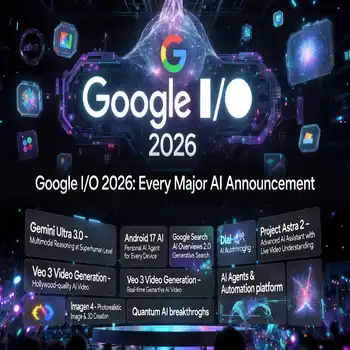
Google I/O 2026 AI on May 19 was the most consequential AI product event of the first half of the year. CEO Sundar Pichai opened with three numbers that reframed the competitive landscape: 900 million monthly active users on the Gemini app, 9.7 trillion tokens processed every month, and DeepMind CEO Demis Hassabis stating that artificial general intelligence is “just a few years away.”
Then Google announced more products in two hours than most companies ship in two years. Here is the full breakdown of what matters and what you should actually pay attention to.
The Headline: Google AI Ultra Drops to $100
The single most impactful announcement for everyday users and business teams: Google AI Ultra dropped from $250 per month to $100. This is the top tier of Google’s AI subscription, offering access to the most powerful Gemini models, higher usage limits, and deep integration across Google Workspace.
At $100 per month, it becomes a serious competitor to OpenAI’s top-tier plans and Anthropic’s Claude Pro. Price compression at the premium tier puts pressure on every AI provider’s subscription economics and signals that Google is prioritizing market share over margin in the short term — a choice a company processing 9.7 trillion monthly tokens can afford to make.
The Scale Numbers and What They Signal
900 million monthly active users on Gemini is a distribution number no competitor can match on its own. Google is embedding Gemini directly into Search, Gmail, Docs, Sheets, Android, and Chrome — products used by hundreds of millions of people who did not explicitly choose AI but are now using it by default.
That distribution advantage compounds over time. Every enterprise on Google Workspace is a potential Gemini Business or Enterprise upsell. The competitive moat is not just model quality — it is surface area.
The AGI Claim That Will Be Quoted for Years
Demis Hassabis saying AGI is “just a few years away” from the main stage at Google I/O will be cited in boardrooms, regulatory hearings, and research papers for the next decade regardless of whether the timeline proves accurate.
What it signals practically: Google is telling enterprise buyers that the AI systems being deployed today are not the ceiling. The organizational changes required to work with current AI need to be designed for systems that will be significantly more capable in two to four years. That planning horizon changes how you architect workflows, manage vendor relationships, and think about human-in-the-loop requirements.
What Was Not Answered (But Should Be on Your Radar)
Google I/O was heavy on product announcements and light on the governance and compliance details enterprise buyers need. Key open questions:
- How does Gemini’s data handling change for Workspace Enterprise customers under the EU AI Act?
- What are the audit and explainability tools for organizations required to document AI-assisted decisions?
- How does the $100 AI Ultra pricing interact with existing Workspace contract structures for large organizations?
Expect these answers through Google Cloud Next and individual enterprise account conversations rather than I/O keynotes.
The Google I/O 2026 AI Bottom Line for Business Teams
If your organization runs on Google Workspace and you have not evaluated Gemini Business or AI Ultra for your team’s AI tooling, the price drop makes that evaluation overdue. Native integration — AI that lives inside the tools your team already uses — is a meaningful operational advantage over running a separate AI subscription on top of your existing stack.
The AGI timeline claim deserves skepticism as a specific prediction but attention as a strategic signal: Google is playing a long game, and they have the distribution to win it if the models keep improving.
The Google I/O 2026 AI and more:
Follow every major AI development: read more AI news on Digital Bright Future →