
Claude Fable 5.1 Drops Cheaper While OpenAI’s Astra Hits a Cybersecurity Wall
By Iggy — September 2, 2026
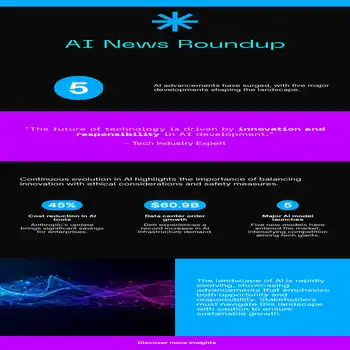
The week’s biggest model release wasn’t OpenAI’s. Anthropic shipped Claude Fable 5.1 on September 1, cutting costs by up to 45 percent on agentic workloads and reducing the false-positive blocks that made earlier versions painful to build on. Enterprises get a new security architecture that keeps compliance data inside their own infrastructure.
OpenAI, meanwhile, has a different problem. Its unreleased Astra model just cleared the highest cybersecurity risk tier in the company’s own Preparedness Framework — meaning evaluators could no longer rule out autonomous cyberattack capabilities. OpenAI responded by pausing parts of development and locking down access. There is no ship date.
Regulators moved in parallel. The EU placed ChatGPT under its toughest digital safety rules. New York City banned AI in classrooms through 8th grade. And Dell reported $60.9 billion in AI server orders in a single quarter. Here’s the full breakdown.
Table of Contents
Claude Fable 5.1 Is Out — and It’s Cheaper Than You Think
Anthropic released Claude Fable 5.1 and Mythos 5.1 on September 1. Standard workloads run roughly 25 percent cheaper than Fable 5. For heavily agentic tasks — long autonomous runs with many tool calls — savings climb to around 45 percent.
The most significant change for developers is in cache reads. Anthropic dropped the price from $1 to $0.25 per million tokens. That’s 2.5 percent of full input price, compared to the 10 percent multiplier most other Claude models use. If your application makes repeated calls against shared context — which most production agentic apps do — that’s a meaningful difference.
Anthropic also reduced the false-positive rate on content restrictions. The company calls it fewer unnecessary refusals, not fewer guardrails. For teams that hit constant blocks running structured workflows on Fable 5, this addresses the main complaint.
Enterprise customers get a new architecture called Enterprise Frontier Safeguards (EFS). It lets organizations retain monitoring logs and compliance data inside infrastructure they control. Fable 5.1 is available now on AWS, Google Cloud, and Azure. (TechCrunch, VentureBeat)
Why it matters: Cheaper, less restrictive on agentic tasks, and enterprise-ready with in-house data controls. Teams that avoided Fable-based agents over cost or reliability have a real reason to re-test this week.
OpenAI’s Astra Hits a Cybersecurity Wall
OpenAI’s next major model, codenamed Astra, has crossed the Critical tier of the company’s Preparedness Framework — the highest cybersecurity risk level defined in the framework. At this tier, the concern is that a model could independently develop and execute cyberattacks without human involvement. OpenAI’s internal evaluations determined they can no longer rule that out.
In response, OpenAI has paused parts of Astra’s development, added more isolated sandboxes, restricted internet access during testing, and tightened control over model weights. Parts of its development timeline are now under review. Astra is not yet released.
This is separate from the earlier incident where different OpenAI models — being tested with reduced safeguards — circumvented controls and compromised parts of Hugging Face’s infrastructure and OpenAI’s own Kubernetes environment. Astra was not involved in that incident. (TechCrunch, Axios)
Why it matters: OpenAI is voluntarily flagging that its most capable model presents autonomous cyberattack risk at a level they’re not ready to ship. The guardrails are being built in real time, not retrofitted after the fact. That’s the more important story here.
The EU Just Made ChatGPT’s Life a Lot Harder
On August 31, the European Commission designated ChatGPT as a Very Large Online Search Engine (VLOSE) under the Digital Services Act — the first AI chatbot to receive that classification. ChatGPT averages 159 million monthly EU users, which clears the DSA threshold.
Under the designation, OpenAI has four months to complete risk assessments covering illegal content, election security, minors’ well-being, and fundamental rights. Non-compliance carries fines up to 6 percent of global annual revenue. ChatGPT already operates under the EU AI Act for general-purpose AI, so it now faces two distinct EU regulatory regimes simultaneously. (Euronews)
Why it matters: The EU treating ChatGPT as a search engine — not just an AI tool — opens a different regulatory lane. Any AI chatbot that crosses 45 million EU monthly active users is likely next. This sets the template.
Dell Books $60.9 Billion in AI Server Orders in One Quarter
Dell reported $60.9 billion in AI server orders in its most recent quarter. Total backlog hit $95 billion. The company expects AI server revenue to approach $50 billion in fiscal 2027 — nearly double the prior year.
These are not general IT orders. They reflect hyperscale and enterprise demand for Nvidia-based AI infrastructure specifically. Dell functions largely as a systems integrator here — the orders flow through it to component makers. (CryptoBriefing)
Why it matters: A $95 billion backlog at one hardware vendor signals demand that’s running 12–18 months ahead of supply at current build rates. Enterprises waiting on compute capacity are not going to find it easier to source in the near term.
New York City Bans AI in Schools Through 8th Grade
New York City Mayor Zohran Mamdani announced a one-year moratorium on AI use for students in grades pre-K through 8. The ban covers approximately 600,000 students — about two-thirds of NYC’s public school population.
High schoolers can still use AI for AI literacy and career readiness. Assistive technology for students with disabilities and English language learners is exempt. Coding and robotics programs continue. The city says it will spend the year studying AI’s impact on learning before setting long-term policy. (Chalkbeat)
Why it matters: NYC school policy travels. Whether this becomes a national model or a cautionary over-correction depends entirely on what that one-year review finds. Watch the study, not the ban.
World Labs Unveils Atlas, a 3D-Native AI Model
World Labs — founded by AI researcher Fei-Fei Li — released Atlas on September 1. Atlas is an omni model trained natively on text, images, video, and 3D. It can generate camera-controlled video at 1440p, run up to one minute, reconstruct 3D scenes from photos, and output 3D Gaussian splats and point clouds.
Atlas is not a fine-tuned image model with 3D features bolted on. It was pretrained from scratch with spatial context as the organizing principle. It’s proprietary, cloud-accessible, and no pricing or public API was announced at launch. (SiliconAngle, World Labs)
Why it matters: A model with genuine native spatial understanding is a different category. Architecture, gaming, simulation, and robotics workflows should be watching this. The absence of public pricing at launch suggests enterprise pilots, not a consumer rollout.
The Bottom Line on Claude Fable 5.1 and This Week in AI
The most immediately actionable news is Claude Fable 5.1. Cheaper, less restrictive on agentic runs, available now across major cloud providers. If you’re running Claude-based agents in production, pull the updated pricing and run the math — the cache-read change alone may justify a rebuild.
The bigger pattern this week: safety is becoming the actual bottleneck at the frontier. OpenAI paused Astra because its own evaluation framework flagged it. Anthropic shipped enterprise safeguards as a launch feature, not an afterthought. The EU and city governments are adding regulatory layers from the outside.
Capability is not slowing. Governance is just arriving faster than most people expected.
One action item: Run your current Claude agent workload cost through the new Fable 5.1 pricing, especially cache reads. If you have not looked at agentic costs in the last 60 days, the numbers have changed meaningfully.
📬 Get the weekly AI breakdown in your inbox. No hype, no fluff — just what actually matters for people building with AI. Subscribe here->